
Word genders: masculine and feminine in Spanish. Rules and exceptions In today's article we are going to discuss a topic that worries all foreign students of Spanish. Let's talk about gender in Spanish. What is gender in words? What are they all
In today's article we are going to discuss a topic that worries all foreign students of Spanish.
Let's talk about the gender in Spanish.
What is gender in words?
What are all the genders in Spanish?
How can we identify it?
Are there rules and exceptions?
In this article we will answer these and other questions related to this grammatical topic, which is the gender of words in Spanish.
Are you ready?
Well let's start! 😉
The grammatical gender in spanish It is present in many words: nouns, adjectives, demonstratives, possessives, pronouns...
That's why it is so important Study it and learn to use it correctly.
To fully understand the meaning of gender, we quote the RAE gender definition:
«When we talk about gender we refer to to the grammatical category inherent in nouns, adjectives and pronouns, which is encoded through agreement in words and which in animated pronouns and nouns can express sex».
The first thing you should know about gender in Spanish is that all nouns have gender, absolutely everyone.
The gender of nouns in Spanish is very easy, just we have two: gender feminine and masculine.
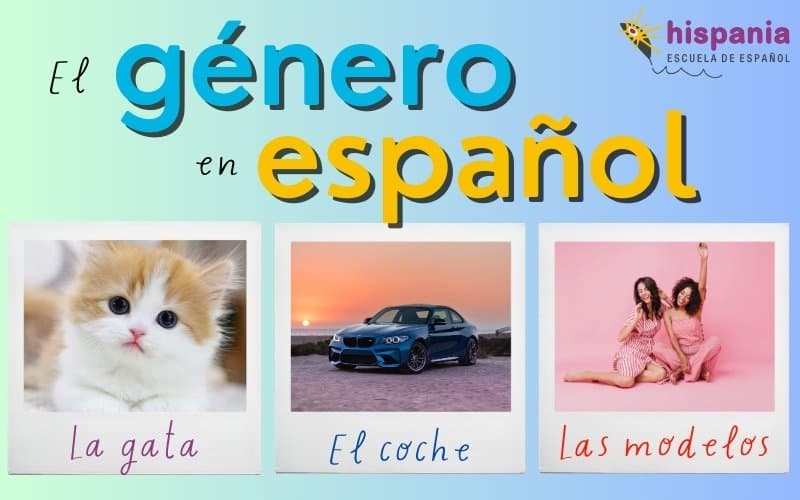
Later we will explain how both types of words are formed, but first we want to give you two examples of gender in Spanish:
What is the gender of the word "girl" in the first sentence?
It is a noun that is feminine. It's clear, isn't it?
And the gender of the word "car" in the second example?
It's masculine. If you look, it has the article "the", that indicates that it is masculine. In the first example, however, the word "girl" is accompanied by the article "the." That article always designates feminine words.
But let's not get ahead of ourselves, as we have said before, later we will explain how to form the masculine and feminine genders 😊.
In many languages there is a neuter gender. It is a gender that is neither masculine nor feminine.
Did you know? There is no neutral gender in Spanish in nouns.
Although the neuter gender does exist in Spanish in other words such as possessives, indefinite, adverbs or demonstratives.
For example, is the possessive "my" masculine or feminine?
Well this one word would be neutral because it is a possessive that can be used for both masculine and feminine nouns.
Examples:
And there are many more.
Words like quite, very, this, that, your, near, far, me or you They are genderless words in Spanish.
other basic look of the genre that you should know is the concordance.
If we have a noun accompanied by another word, for example, an adjective, this word will take the gender and number of the noun.
We have added the adjective "black" to "cat", and since "cat" is masculine singular, the adjective is also singular.
This would happen in the same way if we had a singular or plural feminine noun, as in the following example, where we put the adjective feminine as well.
In this example we have put the adjective in feminine and plural, which are gender and number consistent with the noun «the walls».
Gender and number agreement in Spanish also occurs in other words such as demonstratives, possessives or pronouns.

Now yes, let's see how to identify the gender in the noun.
We warn that at this point we are going to see many rules and exceptions.
Follow the index and you won't get lost.
To form the gender in Spanish there are rules.
We will start first with the most basic rules and then we will go to the more advanced ones.
In Spanish we have 5 vowels: a, e, i, o, u.
We tell you everything you need to know to identify the gender in words that end in vowel.
If the words end in -o, generally they will be gender words masculine.
But be careful, there are some exceptions of words ending in -o and They are not masculine.
If the words end in -a, in general they are feminine.
Just as before, we also have exceptions of words ending in -a and They are not feminine.
In nouns we have many endings which indicate that they are feminine words.
Knowing these endings is very important to speak Spanish correctly.
Do you want to know them? Well let's get to it!
Nouns that end in -tion, -sion, -xion or -zon They are generally feminine.
Let's look at some examples:
some words feminine would be "the reason» or «the seasoning».
Among the masculine we have: the heart, the mailbox, the discomfort, the framework, the swelling, the nipple, the stumbling, the corkscrew, the burning, etc..
The endings -dad and -tad They are very famous among feminine words.
Many words of this gender end like this, especially with -dad, such as the feminine word «university».
Some examples are:
We also have many feminine words that end in -cia or -ía. Let's see some:
These endings are not so common, but we also have quite a few feminine words that end like this:
Finally, other endings that form feminine words are -tud and -umbre.

Let's go now with the endings that designate masculine words. Here we have less than with the female ones.
We have many masculine words that they end in -OR.
Furthermore, as long as these words are people, we can make it feminine adding the vowel -a right after -or.
Masculine words that end in -aje and in -an They are quite common.
As you see, most of these words are masculine nouns, although there are also adjectives, such as lazy or charlatan.
In words that end in -an and designate people, we can make feminine adding -a after -an.
Now you know the most common endings of feminine and masculine words.
But endings are not the only way to determine the gender of a word.
There are many words that do not end with those suffixes but they also have gender.
In this section we are going to see some words that have a concrete gender according to the meaning of the noun.
Are words like numbers, days of the week or months masculine or feminine?
You'll see it below!
The following words all share a common gender. They are all male.
The word "number" is masculine.
Therefore, when we mention numbers, both ordinal and cardinal, we always put a male article:
Two, three, third, four, fourth, ten, tenth, fourteen, twenty-two, one hundred, three hundred and two, etc.
We do this, for example, to indicate the floor of a building in which we live or the lottery number that has been drawn this year:
Examples:
The word color, as it ends in -or, is masculine.
For this reason, when we talk about colors we put a male article:
Red, white, blue, green, black, orange, purple, etc.
Example:
However, the colors can also be adjectives, that is, characteristics of a noun.
If the noun that the color accompanies is feminine, the color will be too.
Example:
Other common nouns in terms of gender are the days of the week.
When we talk about the days of the week, we need to put articles or adverbs of frequency to refer to them.
The articles are always masculine, singular or plural.
Examples:
When we talk about the months of the year, the gender is usually not indicated because we do not put the article.
Example:
However, it is possible to say «in the month of + name of the month». As you see, the article is masculine.
Also in plural:
The cardinal points are: north, south, east and west.
It uses the male article to refer to locations in the cardinal points.
Examples:
In this case, we will only talk about the letters of the alphabet.
Whenever we refer to them we put feminine items:
The to, the d, the and, the f, the g, the m, one u, one t, one r, one yes, etc.
Example:

When we talk about peopleIs the masculine gender man or woman?
And, if we have the gender of the feminine noun, is it a man or a woman?
If the person is a man, the gender will be masculine.
If it is a woman, the word will be feminine.
It's obvious, right?
In the case of the animals It is the same, although here we use the terms male (masculine) or female (feminine).
In many words, if the names of people or animals are men or males, we use the -O ending to designate words with the masculine gender.
In these words that are formed with -O, the equivalent of the feminine form it will be with -A.
To go from masculine to feminine we simply have to change the vowel -o to the vowel -a.
There are feminine and masculine words in the animal kingdom that always end in -a, like «the rat» or «the turtle».
In some words, there is the ending -Or for both sexes.
This means that both genders of the word are spelled the same. For example, the term "pilot», which is masculine and feminine.
To know if the word is masculine or feminine, we simply add the article (the or the).
For form the feminine Of people or male animals there are many rules that you should know.
Keep reading because we explain them to you in great detail.
In this type of masculine words the rule is simple, to form the feminine, simply we add the -A.
Examples:
However, -A is not the only ending to form the feminine.
Sometimes they are needed other suffixes like the ones we present to you now.

Is it possible that the same masculine and feminine noun exists at the same time?
Yes, that's what this section is about.
There are many nouns that are in both feminine and masculine genders, but whose shape does not change.
You could say that they are masculine and feminine words at the same time.
How then do we know if it is a man or a woman?
Thanks to the wonderful articles 🙂.
Remember that we have two types of articles:
The determined ones: the, the, the, the.
The indeterminate: one, one, one, one.
To better understand the gender of nouns in Spanish that they only change with the article, we are going to make a schematic explanation in 5 points.
This way everything will be much clearer.
Look at the examples of nouns below and you will see how they correspond to these types of words.
-A: the astronaut, the filmmaker, the guide, the pediatrician, etc..
Examples:
-ISTA: the journalist, the dentist, the taxi driver, the shareholder, the activist, etc.
Examples:
-E: the janitor, the student, the artist, etc.
Examples:
*The words president, client, boss and saleswoman in feminine they are correct. They are words that end in -e in the masculine.
-AR or -ER: the soldier, the merchant, the schoolgirl, the driver, the sommelier, etc.
Examples:
-L or -Z: the bricklayer, the consul, the spokesperson, the correspondent, etc.
Examples:
*The words judge and councilor They are correct. In masculine they are judge and councilor.
Plains ending in -N or -S: the young man, the bartender, etc.
Examples:
They end in other consonants: the chef.
Examples:
In a concert or an orchestra, there are musicians who play instruments.
The usual way of referring to these musicians is by adding the article to the instrument:
Although you can also add the suffix -ISTA:
In the army or the police there are different ranks and positions. The gender of words in these grades is always written in masculine.
The genre is marked with the article:
There are professions or activities carried out by people that are made up of compound nouns. That is, nouns that are made up of two words.
There are times in which to refer to a person or animal equivalent in feminine or masculine gender, the ending is not changed, but is used another totally different word.
These different words for each sex are called heteronymous.
Let's give a clear example so you understand it.
The word "man" is masculine, right?
What is its female equivalent?
Well, it is "woman", a completely different word from "man".
So the duo man – woman It is one of the most famous heteronyms.
We have a totally different feminine and masculine noun for each one.
Some of the heteronyms of people most popular are:
Man – woman / mother – father / son-in-law – daughter-in-law / godfather – godmother / gentleman – lady / male – female / masculine – feminine / priest – nun / mom – dad.
In the animals There are also nouns in feminine and masculine heteronyms.
These are some:
Bull – cow / crow – magpie / horse – mare / ram – sheep.

On the other hand, we have the nouns epicenes.
These nouns share one word in a single grammatical gender to talk about the two sexes.
For example, the word "person" is a feminine word that can refer to a human being of either sex.
Therefore, "person" is an epicene word.
Some of the epicene nouns for people most common are:
The victim, the character, the person, the people, the baby, the authority, the police, the creature, etc.
Examples:
In the animals There are many epicene nouns:
The fish, the shark, the turtle, the snake, the cockroach, the beetle, the spider, the rhinoceros, the hippopotamus, the ant, the whale, the bird, the partridge, the mosquito, the insect, the giraffe, etc.
Another phenomenon that often happens is when we have nouns that change meaning whether they are masculine or feminine.
For example, the priest and the cure.
The priest is the priest in the Catholic Church.
Instead, a cure is a medicine or treatment to cure or alleviate a disease or illness.
There are a lot of words like this:
the front – the forehead / the guide – the guide / the slope – the slope / the kite – the kite… and many more.
Today we are not going to go into depth with this because otherwise the article would never end 😁.
Although it is a very interesting topic and perhaps in the future we will do an article about it. It's noted!
Now that you have become an expert in grammatical genres in Spanish, it is time for you to show us with the following exercise 😉.
You have to write the gender of the words in masculine or feminine as appropriate.
There are examples of all the rules seen.
Has it gone well?
Everything that involves gender in Spanish grammar is very interesting, as you can see.
Surely you thought this topic wouldn't be that big of a deal, but yes! 😁
If you think that you need to improve other aspects of Spanish grammar, you have to know that in Hispania, Spanish school We are experts in explaining these points in a fun and practical way.
We offer face-to-face Spanish courses and online Spanish coursesadaptable to any level and with a lot of time flexibility.
What gender rules in Spanish mentioned above did you not know?
Do you have any questions about this topic?
Don't hesitate to ask or comment on anything related. We will be happy to talk to you. 🙂
Have a happy day!
Article written by Carlos Martinez for Hispania, Spanish school.
More articles