
Despite the adversities of the current world situation, Hispania, a Spanish school, has chosen to innovate in the modality of its Spanish classes. After the good reception of online Spanish classes in the Hispania Community and the advantages of face-to-face classes in Valencia, Hispania, school
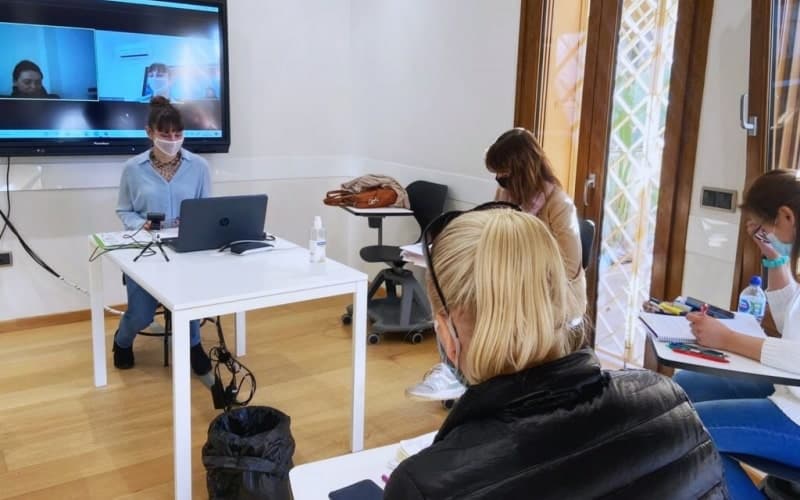
Despite the adversities of the current world situation, Hispania, Spanish school has chosen to innovate in the modality of its Spanish classes. After the good reception of the classes of Spanish online in the Hispania Community and the advantages of face-to-face classes in Valencia, Hispania, Spanish school It also offers its Spanish classes in hybrid format. Below we interview Rita Rodríguez, ELE teacher at Hispania, Spanish school and in charge, together with Ana Maiz, of the internal training of hybrid classes to better understand the advantages of this modality.
I think it's the future. Technological advances offer us unique opportunities and one of them is the possibility of breaking any barrier or obstacle. With hybrid classes you are entering the classroom and at the same time you are entering the world because you bring together people who are in different parts of the planet in a single space. One of the most enriching things about ELE world It is being able to get closer to different cultures and ways of seeing life and hybrid classes make this even more possible.
The students enjoy it a lot because, on the one hand, those who are still in their countries are already beginning to feel like they are in Spain, they are being taught by highly trained native teachers, they talk to other students who are already living here and who can tell them about their experience, give them advice, help... And the students who are in Spain, like the teacher, have the possibility of traveling without leaving their chair.
Pronouncing phrases like “it's very hot here, and how is it over there?” or “it's 9 o'clock here, we just woke up, what about there?” It is something that is priceless.
Definitely. The biggest challenge is to change your mentality about what a Spanish class consists of or what it is like. We teach a language and that requires practice and active participation in class. Furthermore, We follow the Hispania Methodwhich is based on special dedication to each student. Here each student is important and we make sure they feel as such. For this reason, the teacher, previously accustomed to treating students face to face or online, has to manage to combine these two forms of teaching into one and continue making all students feel comfortable and take 100% of their Spanish classes. It is a challenge that we have to accept because it makes us bring out the best in us and become better ELE teachers.
I think the exact word would be excited. One of the things I like most about my profession is that it allows me to meet wonderful students from different parts of the world. This beautiful thing is also very sad because, sooner or later, they return to their countries and the goodbyes are very hard. So when I got to class, connected the equipment, and met up with a former student from Germany, I felt very excited.
Yes, he feed back What students give us is usually very positive because in a time like this of continuous changes, it is a very good way to adapt to any circumstance and continue learning Spanish.
I believe that the hybrid modality is here to stay because we are in an increasingly interconnected world and this is something that helps us continue on that path.
Furthermore, in the case of teaching ELE, it offers students a unique opportunity: to start studying Spanish with their future teachers and classmates before arriving in Spain.
Traveling to a new country, with a totally different language and full of people who are still strangers to you, is something exciting but also a little scary. The fact of having started your classes when you were in your country and knowing that when you arrive you will already have contacts, classmates that you know and even friends, is a very positive factor that gives the student more security.
And not only is the hybrid format the future, but the ELE teacher of the future He is a teacher who completely masters both face-to-face and digital classes, who feels comfortable and strong taking advantage of all the resources of the network and who is always in contact with any part of the world.
Thank you very much, Rita, for granting us this interview and for helping us to better understand the hybrid classes within the ELE teaching!
Article written by Chelo Caballero for Hispania, Spanish school