
Don Juan Tenorio, a classic of the All Saints' festivity. Do you like theater and literature? Well, you're in luck. Today we are going to talk about a work that shares these two artistic expressions. This is Don Juan Tenorio, a dramatic literary work that was published in
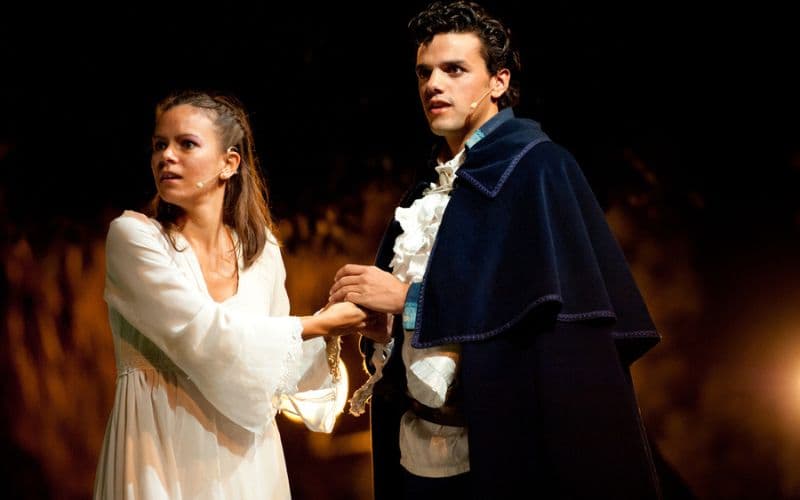
Do you like him theater and literature? Well, you're in luck. Today we are going to talk about a work that shares these two artistic expressions.
It is about Don Juan Tenorio, a dramatic literary work that was published in the middle of the 19th century and premiered as a theatrical performance in Madrid.
Since then, it has become a classic.
Have you ever heard someone say they are a "Don Juan"?
Be a Don Juan It has the meaning of being a very flirtatious man, who is very successful with women.
This expression comes from the protagonist of this work, Don Juan Tenorio.
Now that the All Saints' Day in Spain, this story becomes even more interesting and that is why we are going to dedicate this article to it.
When is All Saints' Day?
This festival is celebrated on November 1, and it is very important in Spain.
On this day we pay tribute to all our loved ones who have passed away in the past.
It is a nostalgic and emotional day. Families often go to cemeteries to leave flowers for their deceased loved ones.
In this post, we will see what is the link of Don Juan Tenorio With this holiday, we will summarize the argument, we will briefly analyze your author and also to the characters of the work.
In Hispania, Spanish school, we want you to learn and enjoy Spanish art and culture to the fullest.
But, above all, we want you to learn Spanish. If you want too, take a look at our face-to-face Spanish coursesin Valencia.
If you prefer, you can also study with us in other places through our online Spanish courses.
Whatever level you are at, we have a course that is right for you.
Do you want to embark on the fantastic narrative adventure of Don Juan Tenorio? Well, join us!
The work of Don Juan Tenorio deals quite a bit with the topic of death and the deceased, hence it is related so much to the All Saints' Day.
The presence of the deceased characters in the outcome of the plot gives the representations of Don Juan Tenorio an aura specifically suited to this holiday.
When is it represented Don Juan Tenorio?
This work acquired a unmatched fame in the second half of the 19th century.
It was common that year after year, in dates close to November 1st, the curtain will rise in the theaters of many cities to reveal the enigmatic story of Don Juan Tenorio.
This success led to a proliferation of new versions, adaptations, sequels and parodies that spread throughout the country.
These performances began to take place outdoors, taking place in settings that harmonized with the spirit of the festival: by the light of torches and, occasionally, in cemeteries.
A particularly notable scene is the dialogue between the gallant and Doña Inés, when Don Juan has already crossed the threshold of death.
In this dialogue, the link between history and the holiday is materialized very well.
To this day, the theatrical representation of Don Juan Tenorio on All Saints It is still a common custom.
 Image from Shutterstock
who wrote Don Juan Tenorio?
Before starting to analyze the work, let's talk a little about the author of Don Juan Tenorio: Jose Zorrilla.
José Zorrilla was born on February 21, 1817 in Valladolid.
During his youth, he was admitted to the Royal Seminary of Nobles in Madrid, where he discovered his passion for literature thanks to authors like Chateaubriand and Fenimore Cooper.
After family migration due to the Carlist War, Zorrilla focused on his legal studies in Toledo and Valladolid.
However, his love of poetry and reading manifested itself in a stronger way, leading him to create friendships with other literary enthusiasts.
Despite his father's attempts at supervision, he abandoned his studies and moved to Madrid to dedicate yourself to your passion.
In 1837, José Zorrilla was still an unknown person who spent his days in the National Library and his nights in precarious circumstances.
Everything began to change when he participated in an emotional act in honor of Larra, it was he who read his verses at his funeral.
This event marked a turning point in his career, as it allowed him to meet prominent figures such as Hartzenbusch and Martínez de la Rosa.
The poet's life was a mix of successes and difficulties.
Despite his literary achievements, Zorrilla was not fortunate in financial transactions and often had to resort to giving public readings to earn a living.
His marriage and his relationship with his family also brought him strong emotional ups and downs.
It was between 1839 and 1850 when José Zorrilla produced his most notable works, like The shoemaker and the king, Sancho Garcia and Don Juan Tenorio.
After emigrating to America for a time, he returned to Spain and experienced a second period in which he received honors and recognition, including admission to the Spanish Academy.
This author died in 1893. José Zorrilla and his most important work left a lasting mark on Spanish literature.
His ability to capture Spanish history and identity through poetry and theater made him an national literary icon.
Among all the works of José Zorrilla, his Don Juan Tenorio It is surely the most famous of all.
The book of Don Juan Tenorio It has famous verses.
There is a very iconic poem that praises the harmony and beauty of the sea.
The poem begins with this famous verse:
"It's not true, angel of love..."
Do you want to read this entire poem? Here it is!
It's not true, angel of love,
that on this secluded shore
purer the moon shines
and do you breathe better?
This wandering aura fills
of the simple smells
of the peasant flowers
That pleasant shore springs up;
that clean and serene water
that crosses without fear
the fisherman's boat
that waits singing for the day,
Isn't it true, my dove,
who are breathing love?
Nice, right?
You already know some important things about Don Juan Tenorio by José Zorrilla, such as its connection with All Saints' Day, the biography of the author and one of the most famous poems in the work.
But what is the argument of Don Juan Tenorio?
In the introduction of this post we have already talked about the womanizing nature of the character.
The work narrates the life of this man who presumes to be a conqueror, to have all the women he wants in his arms.
This seducer mocks all established social values, and that is why he is considered a sinner. But his life will change when he meets Doña Inés.
This would be the synopsis. Next, we show you a summary of Don Juan Tenorio, divided into the two parts that the work has.
We warn that there will be spoilers of the most important events and the ending, so if you are interested in seeing the play without knowing what is going to happen, we advise you to skip this part.
In the first part of the work the story is presented during Carnival night and Don Juan Tenorio is in Seville.
Don Juan and Don Luis Mejía, two noblemen, had made a bet a year earlier, in which they competed to see who could conquer the most women in a year.
The story begins a year after this bet, when Don Juan and Don Luis meet at the Laurel de Buttarelli inn in Seville.
The delusions of grandeur of both continue to grow and they increase their crazy bets for the ambition to surpass the other.
The meeting and the extravagant conversations between these two characters cause a big scandal at the bar, and everyone echoes what kind of people they are.
Don Gonzalo de Ulloa, the father of Mrs. Ines, who was destined to marry don Juan, is present at that moment.
He discovers to his horror the type of person Don Juan is and that is why he forbids him from marrying his daughter.
However, don Juan infiltrates the convent and kidnaps Doña Inés and both They fall madly in love.
Time passes and the rivalry between don Juan and don Luis becomes so toxic that they reach the worst possible scenario: a duel to the death.
Inés's father decides to join Don Luis to end Don Juan's life. However, don Juan manages to kill both in the duel.
The first part ends with the protagonist escaping to Italy on a boat
5 years after Don Juan escaped to Italy, the protagonist decides return to Seville.
Don Juan is now a totally tragic being, saddened and full of remorse for what he did.
Visit the cemetery where Don Gonzalo and Don Luis are buried.
Unfortunately for her, there is also the tomb of Doña Inés, which died of griefwhen she found out that her lover killed her father and abandoned her when she had to flee to Italy.
It is discovered that Doña Inés did a deal with god before dying:
They agreed that Don Juan would be saved from going to hell for all his sins if he could make him repent of his actions at the end of his life.
When don Juan returns home, he appears the spirit of Don Gonzalo, and it is here when the relationship with November 1 is established, All Saints' Day.
The ghost of Don Gonzalo, Inés's father, wants to take Don Juan away. to hell.
However, the ghost of Doña Inés also appears to defend her loved one.
Don Juan, completely dejected, regrets all the harm he has committed throughout his life. In this way, Doña Inés fulfills the deal made with God.
Therefore, in the ending of Don Juan Tenorio, when the protagonist dies, his soul is taken to heaven.
Now, the soul of Don Juan and Doña Inés remain together forever.
 Criben / Shutterstock.com
now you know What Don Juan Tenorio is about.
In any case, it is only a summary and the emotionality and complexity of the work, whether literary or theatrical, cannot be expressed in a few lines.
We recommend that you experience it in a theater.
Now let's go describe the main characters by Don Juan Tenorio and the roles they have.
Don Juan Tenorio is the main character. He personifies everything immoral of his time.
He is arrogant, a womanizer, vicious and shows contempt for religion and death.
He manipulates and deceives women for his own interests, without caring about the consequences.
The character of Don Juan is so influential that the term "Don Juan" was coined to describe someone who seduces women and what do you prefer temporary relationships instead of compromising.
However, at the end of the play it is revealed that Don Juan's true love is Doña Inés.
The myth of Saint John It has had a profound impact on literature and other artistic expressions such as theater and cinema.
This character became a archetype which, to this day, is still used in many novels and films.
For example, we all know the seductive skills of the famous spy James Bond, right?
Surely the character of José Zorrilla served as inspiration for Ian Fleming's iconic hero.
Doña Inés is the other central figure in this romantic drama.
Daughter of the commander and fiancée of don Juan, Doña Inés is a 17-year-old girl who represents innocence typical of adolescence.
She is a young woman pure and kind who strictly follows the religious teachings and social norms intended for a girl of her position and her time.
Since her childhood, she has been hospitalized in the Calatrava convent by order of his father.
Despite everything, Doña Inés falls deeply in love with Don Juan, just the type of man that Doña Inés's father detested for his daughter.
This love and the opposition of Inés's father trigger the tragic events that we have mentioned before.
The pain that Doña Inés suffers After discovering that her lover has killed her father, she is so strong that she finally dies of grief.
Despite everything, even in death she still loves don Juan and her spirit helps him save himself.
Don Luis Mejía is the other rival gallant of don Juan.
The friendship between the two is corrupted by desire for competitiveness and for wanting to be better than the other in the act of seducing women.
What begins as a game ends in a duel to the death, losing his life at the hands of the one who was previously his friend.
These would be the main characters of the work. There are also other important secondary ones such as Don Gonzalo de Ulloa, the father of Doña Inés, or Don Diego Tenorio, don Juan's father.
The repertoire of characters does not end here. In the play there are many characters who have small roles but who enrich the story with his appearances.
Some of these characters are:
And many more.

Don Juan Tenorio is a literary and theatrical work that represents the characteristics of the Romanticism, an artistic movement that emerged in Europe in the 18th century.
Zorrilla explores fundamental themes such as morality, through the contrast between the depravity and purity.
The themes of impossible love, the passion and regret that we see in Don Juan Tenorio are also very present in romantic works.
The religion and faith These are other recurring themes of this artistic movement.
Much importance is given to spirituality and the soul, combining it with what supernatural.
In line with the romantic aesthetic, the work highlights the mystery, the night and the dark.
And, of course, we couldn't miss a tragic outcome typical of this current.
You can see Don Juan Tenorio in the theater at many parts of Spain.
Although there are some cities where it is more popular.
Do you want to know them? They are the following:
The first time Don Juan Tenorio's play premiered was in Madrid.
In Alcala de Henares, a city located northeast of the capital, this work is followed with great devotion, even today.
In fact, there has been an annual festival since 1984 dedicated to it: the Don Juan Festival.
Here the play is staged in the walled enclosure of the Archbishop's Palace.
Also in the city of Guadalajarais followed with enthusiasm. The way of representing the work here is very peculiar.
It is called the Tenorio Mendocino and is celebrated for two nights around November 1st through the streets of the city, outdoors.
Curious, right?
We pass from the center of Spain and fly to Las Palmas de Gran Canaria, capital of the Canary Islands.
This island has been doing the show for more than 10 years in the historic center of Vegueta.
Each year the date varies a little, but it always revolves around All Saints' Day.
It is curious that, in 2017, they took the risk of creating a different function, with rock music as an accompaniment.
José Zorrilla was born in Valladolid. As could be imagined, the author's hometown He holds him and his works in great esteem.
In fact, there is a theater that pays tribute to him: the Zorrilla theater.
In this theater, performances of Don Juan Tenorio are usually held every year in the All Saints' Eve.
So now you know, if you feel like doing something different on this day, you can find out if this play is done in the city you are in.
Did you like the article? In Hispania, Spanish school We love talking about culture and art, it is usually a recurring topic in our Spanish classes.
Did you know the myth of Don Juan?
Does it also exist in your country?
If so, put it in the comments.
See you!
Article written by Carlos Martinez for Hispania, Spanish school.
More articles