
Discover everything you need to know about the Valencia metro in Spain. Wondering what transportation is like in Valencia? Then this article interests you! Today you are going to discover how the Valencia metro works. We will see what their lines are and where they pass, ticket prices, stations
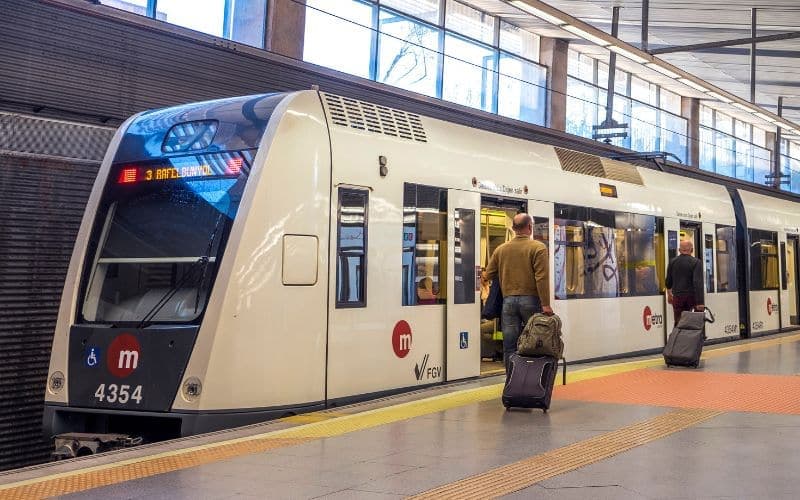
Are you wondering what transportation is like in Valencia? Then this article interests you!
Today you will discover how it works the Valencia metro.
We will see what they are its lines and where they pass, ticket prices, main stations and much more.
With several lines that connect different destinations, the metro is a very fast option to get around the city of Valencia.
Almost all important places have Metrovalencia outlets nearby, like our school! 😁
If you get off in the Facultats stop, in 5 minutes on foot you will reach Hispania, Spanish school.
Here you can study in our spanish courses and learn the language with a totally practical approach so that you can practice it from the first class.
Do you want to know more things about the Valencia metro?
Well don't get lost, let's get started!
We begin by briefly talking about the History of the Valencia metroa.
The inauguration of the Valencia metro took place in 1988.
Since its inception, the Valencia metro In Spain it has experienced considerable growth.
Over the years, there have been added new lines in the MetroValencia network and renovation work has been carried out in the existing stations.
An effort has also been made to modernize infrastructure and expand platforms.
Today, the Valencia metro is one of the most modern, comfortable and safe in all of Spain, which continues to grow and improve in a city that is constantly evolving.

Ander Dylan / Shutterstock.com
Currently, Metrovalence has 9 lines that connect practically with the entire city and some surrounding towns.
In the Valencia Metro map You can see that each line has a specific route and different stations that allow users to quickly move around Valencia.
Do you want to know what these lines are and where they lead?
We tell you!
The line 1 of the Valencia metro goes from the town of Betera until the municipality of Villanueva de Castellón.
There are stops on line 1 of the Valencia metro in different areas of Gran Vía, near the center of Valencia.
Some of these stops are Empalme, Turia, Plaza de España or Joaquín Sorolla.
In addition, the line also connects with many beautiful towns in Valencia to go by metro such as Godella, Picassent or L’Alcúdia.
inside the city of Valencia, the line 2 It passes through exactly the same stations as line 1.
As for the municipalities it connects, these change.
In the part of Llíria we have stops like L'Eliana or The Canyada. In the Torrent Avinguda area stops are made in towns like Picanya or Paiporta.
If you're wondering how to get from Valencia to Torrent by metro, here's your line!
The line 3 It is one of the busiest, since it passes through very busy areas of the historic center and by others emblematic neighborhoods like Benimaclet or the university area of Blasco Ibáñez.
Do you want to get to the center quickly? This line will leave you right at Colón or Estació del Nord.
Additionally, with this line you can go to Valencia airport by metro directly.
The lines 4, 6 and 8 are from intercity tram.
These trams go down the street to very concrete. Line 4 is known because it does stop at the Polytechnic University of Valencia and in the University of Valencia, on the Tarongers and Burjassot campuses.
In addition, it also makes several stops right next to the Malvarrosa beach and of the Sands, the main beaches of Valencia.
The line 5 It takes almost the same route as 3. Cross Avenida del Cid, Mislata and ortros towns of Valencia with metro until you reach the airport.
You can also use this metro line from Valencia airport to the historic center. It makes stops in busy places like Angel Guimerà, Columbus and Alameda.
The difference with line 3 is that it does not deviate towards Benimaclet and Alboraya, but continues straight along Amistat and Ayora.

Saiko3p / Shutterstock.com
The line 6 MetroValencia is by tram and also takes you to the beaches and the port area.
However, part of the Tossal del Rei stop, in the area of Levante stadium and Orriols.
It has a shorter route than line 4.
We continue with the MetroValencia line map.
The line 7 of the Valencia metro Connects the Marítim Serrería stop with Torrent Avinguda.
It goes from the old fishing neighborhood of Cabanyal until Torrent passing through some stops in the center of Valencia such as the eJoaquín Sorolla station and Patraix.
The line 8 tram It is the shortest of all. It's only 4 stops. Serves as extension of the lines 5 and 7 meter.
It goes from Marítim Sawmill until the Royal Navy, the laziest area of the port of Valencia.
If you are wondering how to get to the port of Valencia by metro, this is your line!
The line 9 It takes almost the same route as the 5. Instead of starting from Rafelbunyol, it does so a little further on, in Alboraya (here are the best horchatas in the city!).
This line does not go to the airport, but makes a detour to Riba-roja del Turia. In this town you can see the Turia River in all its splendor.

Ima-ss / Shutterstock.com
In the Valencia metro there is many fees depending on the type of ticket.
The most common is the bonus ADD 10, what does it cost 8 euros within the same area and gives you 10 trips.
There are also single travel tickets or special airport tickets.
It should be noted that the MetroValencia stops are distributed in 4 zones (A, B, C and D).
What is the zone A of the Valencia metro?
They are all stops that are within the city of Valencia.
The rest of the areas correspond to the municipalities as they move away from the city.
Take a good look at the Valencia metro map to see which area each stop is in.
What time does the Valencia metro close?
The Valencia metro It is active almost all day.
between week from 4 in the morning until 11:30 p.m..
The Valencia metro in the weekend it works from 5 until 00.30 a.m..
How often this usually happens depends on the line, but it is usually every 10 minutes.
In Valencia there are many stations that are very busy, like the station Xativa, Columbus or Angel Guimerá.
Below we explain why they are and what you can find in each of them.
The popularity of the Xativa Metro station in Valencia due to its location.
It is in the heart of the center of Valencia, right next to the train station and a few minutes walk from the Town Hall Square.
If you want to access the Valencia center To walk, have a drink on its emblematic terraces or go shopping, this station is one of the best options.
Near this station there are usually street stalls selling horchata, corn on the cob or chestnuts.
Sometimes even within the station itself. Do you dare to try them?
The Columbus station It is also very popular for its location.
It is located right at the beginning of the Colon Avenue, one of the most elegant and beautiful avenues in the city, full of clothing stores and other establishments.
If you reach the end, you will find the bus stop. bullring metro and the Valencia North Station.
The Ángel Gumera Station It is not as central as the previous two.
However, many people pass by because connect many lines subway, transferring in it.
In addition, it is one of the stations that best connects the historic center of Valencia with the most residential neighborhoods.

Markus Mainka / Shutterstock.com
Are you wondering what is the most beautiful metro station in Valencia?
We are clear: the Alameda station.
This metro station is considered one of the most beautiful in the world. It is located in the Turia Garden, just under the Peineta Bridge.
Its beauty is due to its modernist architectureand to the lots of natural light received.
Santiago Calatrava He designed it with his characteristic style of white, pointed structures. If you have visited the City of Arts and Sciences, you will quickly recognize his style.
The roof of the station is covered with windows through which sunlight enters, making the station one of the brightest in the world.
The Valencia Metro has expansion plans to improve connectivity in the city.
It is anticipated creation of new lines and the expansion of existing ones.
Among the planned expansionsand find the Line 10, that will connect the Nazareth area with the Polytechnic University of Valencia.
In addition, the possibility of a Line 11 that connects the city center with the Benimàmet neighborhood.
These new lines will decongest some of the busiest routes and provide additional transport options for the inhabitants of Valencia.
Finally, we are going to talk to you about some curiosities of the Valencia metro that may surprise you.
The first curiosity is that the Valencia metro has one of the longer lines from all over Spain: Line 1 which goes from Bétera to Villanueva de Castellón.
This line makes a total of 41 stops in different seasons.
Did you know that the Valencia metro network has more than 156 kilometers of roads?
This makes it one of the largest in the country. 👏🏻
Furthermore, Metrovalencia is not only limited to the city, but is one of the most supportive of the surrounding towns. More than 35 municipalities They have a metro stop.
Another curiosity of the Valencia metro is the cultural aspect that sometimes he receives.
In some festivals, events are held within the stations of some meters.
For example, during the Book Day, to encourage reading, free books are distributed in some subway stations, encouraging reading among users.
Also in the failures Some metro stations become meeting points for passengers to Fallas artists expose your ninots, the popular papier-mâché figures that are burned at the end of the festivities.
And we're done!
We hope that this article has helped you better understand what the Valencia metro and where all its lines pass.
Dare to use it more often! It is a very fast and efficient form of transportation and is very well distributed throughout the city.
And remember to make a stop at Faculties to study Spanish with us in Hispania, Spanish school 🤗.
Of the lines mentioned, which do you use most often?
Which station do you think is the most beautiful in Valencia?
Tell us in the comments.
A big hug!
Article written by Carlos Martinez for Hispania, Spanish school
More articles