
Celebrations in Spain: vocabulary and expressions about parties After the articles on the carnival, we came up with the idea of creating a general vocabulary guide to talk about the parties in Spain. This article will be divided into the following sections: Useful verbs to talk about f
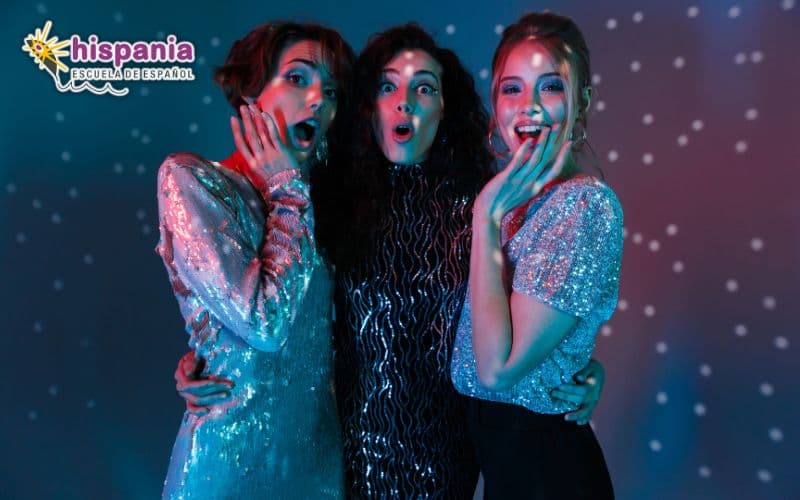
After the carnival items, we came up with the idea of creating a vocabulary guide general to talk about the parties in Spain.
This article will be divided into the following sections:
Finally, as we usually do in all articles in which we deal with a topic of grammar or vocabulary, we propose a activity to better assimilate the content.
Let's start with the verbs! 👉
There are many verbs that we Spaniards use at parties or celebrations. These are some of the most used:
When we have a plan with someone to go somewhere, we use the verb «stay with someone».
Furthermore, we can add «to do something» to specify the plan to be made.
It can also be used in more formal contexts, not just at parties.
There seems to be no doubt that "go out to party» is used only for parties.
It is the most common verb when we go to a disco, pub, guateque or del type of party whatever.
A synonym for "partying" is "go to party».
In a more colloquial way, we can also say "go partying».
The word "farranda" is another way of saying party.
«go have a drink» is one of the most popular phrases for going out with friends.
It is used when we want get out of one gentler way, just to enjoy a drink on a terrace, chat with friends, enjoy the atmosphere and that's it.
To give you an idea of the Spanish schedulesWhen we say "partying," we are thinking about returning home between 6 and 7 in the morning.
When we go out for a drink, the return time is usually no later than 3 in the morning.

«Go out for a drink» means exactly the same as the previous verb. Both the verbs "go" or «leave» they express that we are going out for a drink, and not at home.
Since the weather is generally good in Spain, we Spaniards love going out to have a drink with friends. We don't usually do it at home.
«Celebrate» is having a party for someone reason.
We can celebrate a wedding, celebrate a salary increase, celebrate an important day in your country, celebrate the carnival...
Do you understand?
In our Spanish culture we love to celebrate events.
«Celebrate» is to perform public events, ceremonies, meetings, shows, fairs, etc.
We also use this verb to commemorate an event through a party.
When the celebration goes dedicated to someone In particular, we can use this sentence: have a celebration in honor of someone.
The verbs that we just saw are going to work very well for you whenever you are going to meet friends or celebrate something, so write them down well.
There are many celebrations in Spain that we love to enjoy.
For this reason, we have prepared an essential list of party vocabulary in Spanish.
These words are going to be your dictionary for partying in Spain.
Thanks to them, you will understand people much better when they talk about celebrations, since there are many that are only used in this context and you probably don't know them.
Do you want to know them? There they go!

Do you know that in Spain each town has its local festivals?
Spanish towns have a lot of personality, even the smallest ones.
It is in the summer months when the village festivals. The town hall of each town is in charge of organizing the festivals.
The town festivals more typical They are bullfighting events, music concerts, sporting events, troupe parades or eating contests.
For example, in many towns in the Valencian Community Paellas are made in the street for all the inhabitants.
Each town also has its unique festivals, such as Tomatina de Buñol, in which people engage in a tomato war at the end of August.
one verbena it's a small open air concert with artists who sing popular songs that all Spaniards like to sing and dance.
The festivals usually take place at night and are held during the most important festivals.
In Valencia, for example, there are festivals during the failures or in the night of Saint John.
If you want to know those songs that have always accompanied us at every party, go to several festivals and you will recognize them.
As? It's easy, people start singing and dancing to them with euphoria.
We have already talked several times about parades and parades, but do you really know what is the difference between both?
the word "cavalcade" It comes from the verb to ride. This is the action that riders do when they ride a horse and they walk with him.
Therefore, a cavalcade is originally a parade of horsemen, floats and horses that take place on days of great celebrations.
a parade, on the other hand, does not have to have horses.
It may simply be people walking, playing musical instruments and dressed in traditional clothing representative of the festival being celebrated.
The brass bands They are a fundamental part of popular festivals.
They are music groups that play wind and percussion instruments, animating the celebrations that take place in the streets.
You can hire brass bands for almost any festive event: a wedding, a bachelor party, local festivals, parades...
The bottle It was born at the beginning of the year 2000 at the university parties.
The students who could not afford to have drinks inside the premises bought the drink at the supermarket and made it themselves. their own vats.
Where were they taken? Well, on the same street.
It is necessary to emphasize that make a bottle in Spain today it's illegal and it is fined by the police. So now that you know what it is, don't do it!
The pilgrimages They are related to the Catholic religion.
It is apilgrimage to a hermitage where there is an important figure such as a saint or the virgin.
People who make these spiritual journeys seek protection or other favors in exchange for fidelity towards that saint or virgin.
The pilgrimages can also be a religious festival that is celebrated with dances and food near a hermitage.

One of the most beautiful acts to open or close a celebration is the fireworks castle.
Fireworks are rockets that are launched into the sky and when they explode they fall apart. colored lights.
All castles are supervised by an expert in the pyrotechnics.
By the way, did you know that the person who is considered the best pyrotechnician in the world is from Valencia?
It's called Ricardo Caballer and puts on fireworks shows all over the world. 😊
In the pilgrimages section we have mentioned the hermitages.
The hermitages They are very small chapels or churches dedicated to a saint. They are usually on the outskirts of the city, in an unpopulated area.
The procession It is a religious parade of people.
Images of religious figures are carried such as Jesus Christ and the Virgin Mary.
These people go from one place to another, guided by the clergy, as a sign of their religious faith.
In Spain, the most famous processions take place in April during the Holy Week, a festival that commemorates the death and resurrection of Christ.
Before we have mentioned the bullfighting festivals of the towns in summer. They are called "bull runs».
They are called that because the bulls They are limited to a few streets in the town. The bravest run ahead of them and some even overcome them.
The bulls they can be very dangerous. If you are curious to see them, you can find out about a town that makes them so you can go see them.
But we recommend that you stay behind the fences and do not enter the premises. Let's leave that only to the experts.
Do you prefer a quieter and safer activity?
Then maybe go shopping the markets be what you are looking for. 😁
It is common for markets to open on many holidays. outdoors. In these stalls you can find clothing, food and many handmade products.
The best of all are the prices, which are quite lower than in conventional stores.
They are especially beautiful medieval markets where you will find products inspired by that time or delicious food that was eaten back then.
In Spain there is a long tradition of markets. There are towns where they are held almost every Sunday.
If you are in Valencia, you will find many public markets.
For example, there is the Ruzafa Market which opens every morning from Monday to Thursday.
You can also go to Trail.
This is a large open air produce market second hand which is celebrated every Sunday morning in theOrange Tree Avenue.
It is very interesting, especially for antique collectors. 👌
The proclamation is a official announcement of a recent important news.
It is dictated by a public official in an iconic place in the town, such as the main square.
As you can imagine, this practice was common in the medieval age, when there was no media such as the press or television.
The only way people had to find out about current events It was to go to the center of town and listen to the proclamation.
Even so, today in many localities keeps remembering the figure of the proclamation to start the festivities.
It is wonderful that, despite so many centuries having passed, the proclamation act It's still happening, don't you think?

In summer, many Spanish cities and towns set up the fair.
The fair is a place where there are amusement parks. something like disneyland, but in miniature.
The most symbolic attraction of a fair is the ferris wheel That wheel that rotates slowly up and down offering beautiful views of the city. 🎡
But it is not the only one, at the fair we found other attractions like:
And what do you eat at fairs?
Nowadays many people eat hot chips, but traditional food has always been the super sweet cotton candy.
Another way to start a party is by launching a small rocket. This is called "chupinazo».
This practice is especially common in areas of the north of the peninsula Spanish, as in Basque Country or in Navarre.
One of the most famous chupinazos is the one made in Pamplona to inaugurate the festivities of San Fermin.
the word itself discomobile It already tells us what it means, right?
"Disk" and "mobile", that is, disco that moves.
Discomobiles are cheaper than festivals, since they do not need singers, but simply a good music system and someone to play the songs or, at most, a DJ to play.
Normally, discomobiles, like festivals, are set up on small stages in the middle of the street.
When the party is over, it is dismantled and the street is free again.

The municipal music band It is the music band that represents a municipality.
Each municipality can have one and is normally made up of symphonic instruments, which are the following:
A patron is a protective saint of one specific community.
The concept of patron saint means "advocate before God».
There are patterns for practically everything: workers, carpenters, animals, engineers, etc.
Rural Spain has a long Catholic tradition. For that reason, each town also has its patron.
The village patron is he protective saint of a town.
Each town has its own patron saint with whom they identify and feel defended.
The rocks They are groups of people with common interests who carry out activities together.
They can be activities of various kinds, such as cultural, sports or gastronomic.
Do you want to know some examples of rocks?
For example, you can create a club to play cards with friends.
Another thing could be to go watch your favorite team's soccer games.
The festival commission of a town is a group of people which, on a completely voluntary basis, is responsible for organize and launch the town festival schedules.
If the festival commission is the main organizer, the nails are the protagonists of the celebrations.
They are the face of the parties and the representatives. They carry out the most relevant acts.
Being clavario is a custom that usually passes from parents to children.

We continue to expand the vocabulary about parties in Spanish with some useful expressions.
Surely you have heard these many timesexpressions in spanish.
Now you're finally going to find out what they mean. 😉
This is one of the party and friends phrases that are most heard among Spaniards.
Do you have the typical friend who lives to party? He goes to everyone, even when he's sick!
For this type of people we use the expression "not to miss a single one".
Are you one of those who don't miss a single one? Do you go out partying every weekend?
Sometimes there are festivals so popular that they are full of people.
In those cases we use the expression "to be filled to the brim".
"Not a soul can fit" It has a similar meaning to the previous expression.
Although there are still more people here. There are so many people at the party that literally no one else fits.
When this happens, it usually has a negative connotation because it is overwhelming.
«Celebrate something with great fanfare» It is another of the funny phrases to celebrate.
It means to do a big party, without any type of limitation.
Bass drum and cymbal are percussion instruments that are often played at the best parties. That's where the expression comes from.
You can also say "celebrate something in style."
The expression"throw the house out the window" is to signal that someone is spending a lot of money or more than you can afford.
An adjective for this can be "wasteful".
Although it is also used on special occasions that deserve that big expense, such as a wedding or a honeymoon trip.
In these phrases of party and fun, the person who cuts cod is the one who wears the leadership of the group.
They can also be an important person because they provide economic resources or are part of the organization.

We think this is one of the funny Spanish expressions related to the party.
"There are four cats" It is the opposite of the previous expressions,
It means that there is very few people in the place. It is jokingly said that there are only four cats. 🐈⬛😂
"Be the life of the party" It is one of the most heard phrases for nightclubs.
It is said when someone receives the interest of people because they have a overwhelming personality.
Those who are the life of the party are usually the center of attention.
That is, they are people who cool a lot. Don't you know what molar means in Spain?
It is a verb of informal use. It serves to express that a person is interesting and charismatic.
Unfortunately, sometimes there are people whose goal seems to be to boycott the party. They complain about everything and they always see the bad side of everything.
Those people spoil the party.
In every celebration in Spain, there is always a party pooper. What is going to be done? 😑
How are you? Surely all this party vocabulary in Spanish It has been very new for you.
Therefore, we are going to make you review it with the following exercise.
You must choose the correct option for each statement. Luck!
Do you find it difficult to remember new words in Spanish? A good way to do this is by Hispania Method.
Our method, endorsed by prestigious institutions in the language teaching sector, guarantees solid and practical learning of Spanish.
You can access it through our face-to-face Spanish courses or online courses in Hispania, Spanish school.
Would you like to be the life of the party in your Spanish class?
Do you know other expressions related to holidays and celebrations that we have not mentioned?
Comment and we'll talk. 😊
Article written by Carlos Martinez for Hispania, Spanish school.
More articles